
Data-Driven Clothing Design
Laura Civetti's Adaptive System
In Adaptive System, Laura Civetti and Juan Daniel Cabrera Cobo turn maps of movement, heat and sun exposure into 3D-printed garments shaped around the body that wears them.
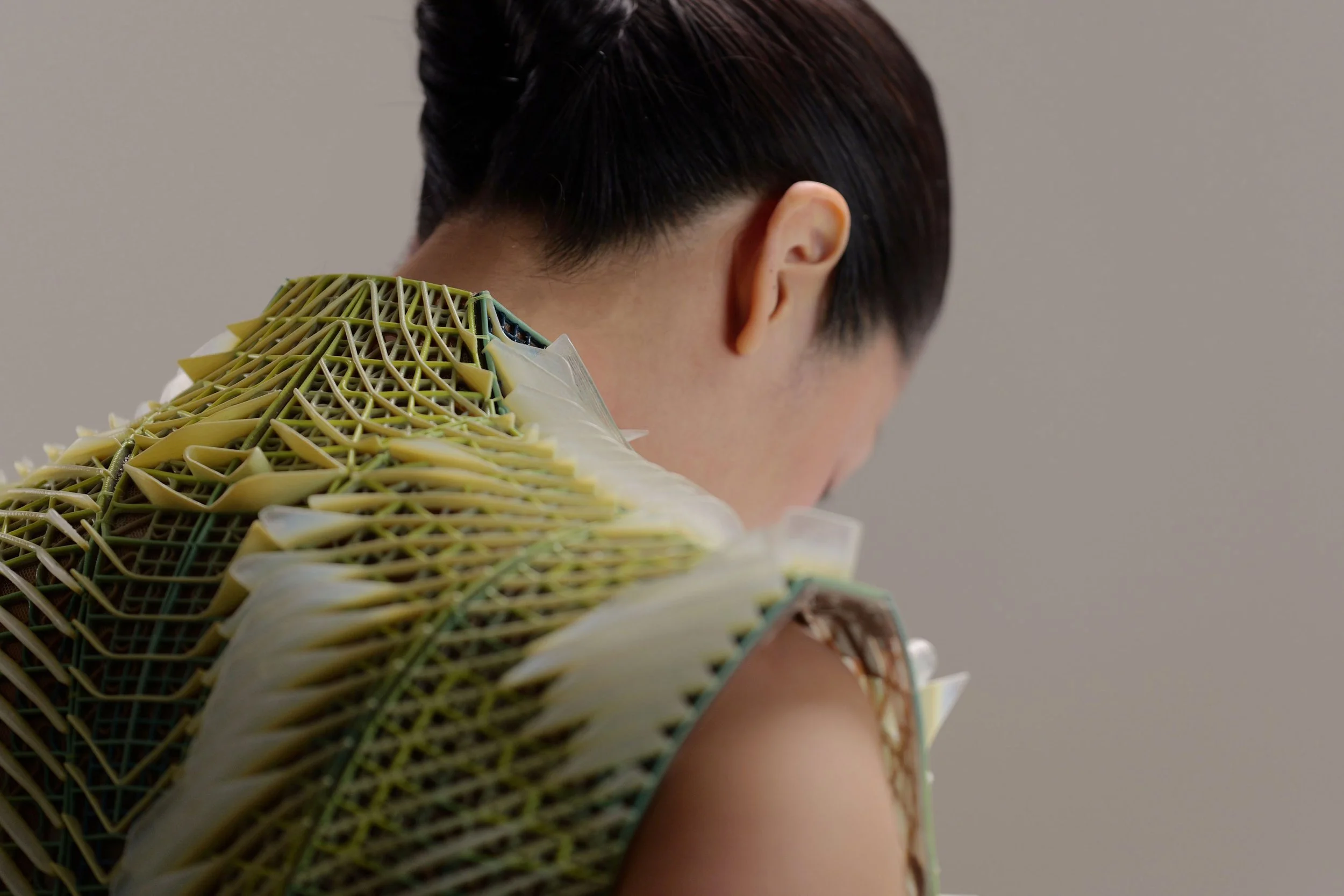
Adaptive System by Laura Civetti, worn by Rowena Lee. Photo: Gabriele Pampanelli
We now have access to more information about the human body than ever before. Posture, movement, heat, perspiration and exposure to the sun can all be captured, mapped and turned into measurable parameters. Most of this data is used to observe: to track, monitor and report back on what a body has done.
Adaptive System puts that information to work. It is less a single garment than a method: a data-driven way of bringing the body's physiological needs into the design process from the very start. What it produces are multifunctional, differentiated, high-performance textiles and garments, each shaped around a specific body rather than an average size.
The idea draws on how the body itself works. Skin is not uniform: its thickness, its sweat glands and its exposure to the sun vary from one area to the next, each suited to a particular need. Clothing, even technical sportswear, usually addresses these needs separately, one fabric or panel at a time. Adaptive System asks how a single textile could address them all at once.
The method begins with colour-coded maps of the body showing its curvature, areas of perspiration and exposure to the sun. A computational design process reads these maps and turns them into three layers. Lines drawn from the body's curvature support natural movement. Heat data adjusts the density of a mesh, opening it up where the body runs warmer. Solar data sets the thickness and orientation of the material where protection is needed. Combined, the layers form one surface in which each area performs its own function.
Additive manufacturing makes that surface possible. Working with Stratasys, the team builds the garment grain by grain, so density, thickness and transparency shift gradually rather than changing at the seams. The data becomes, quite directly, the behaviour of the material.
In other words, instead of creating one design and scaling it up or down for an average body, Adaptive System designs from the data of the person who will wear it. That shift raises new questions. How could such personal garments be repaired or adjusted as a body changes over time? Which materials could offer this level of precision and still be recycled or composted at the end of their life? And who should own the body data they rely on?
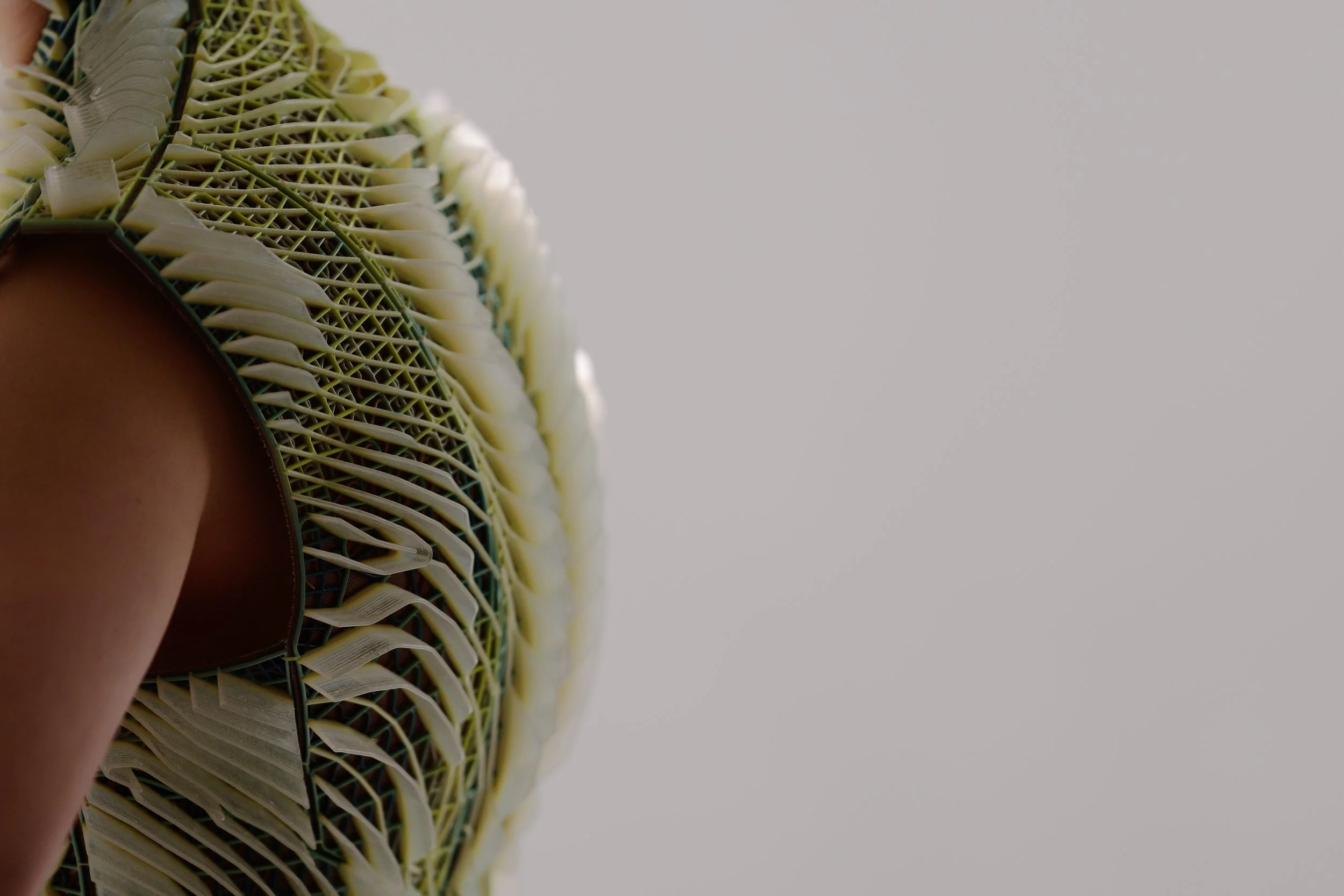
Adaptive System by Laura Civetti, worn by Rowena Lee. Photo: Gabriele Pampanelli
About the designer
Laura Civetti is a fashion tech designer and researcher working across computational design, digital fabrication and garment design. Treating data as a design material, she brings together the human body, materials and additive manufacturing to develop new design methodologies. Her work ranges from generative pattern systems to bio-based 3D-printed structures, shaped by a close engagement with sustainable practice.
Civetti studied Interior Design at IED (Istituto Europeo di Design) in Milan, writing her thesis on eco-yacht design, before turning to emerging technologies in the textile industry. In 2018 she attended Fabricademy at Fab Lab Barcelona, a transdisciplinary course on new technologies for textiles connected to MIT's Centre for Bits and Atoms. In 2023 she completed a Master of Science in Computational and Advanced Design at DesignMorphine.
Her career began with an internship at the Iris van Herpen atelier in Amsterdam. At Noumena she moved from wearable technology projects to the role of Head Fashion Tech Designer, leading research into material development and additive manufacturing for the body, and coordinated Reshape, a design platform, contest and event seeking emerging designers for future industries. In 2020 she joined Materfad, the Barcelona Materials Centre, as a project manager supporting companies in developing new materials, and in 2023 she became a senior designer at Nagami, working at the intersection of computational design and additive manufacturing.
Today she is co-founder, with Juan Daniel Cabrera Cobo, of Quasizero, a Perugia-based studio that develops 3D-printable materials from organic by-products, and lectures at Elisava School of Design and Engineering, IED Milano and Domus Academy.
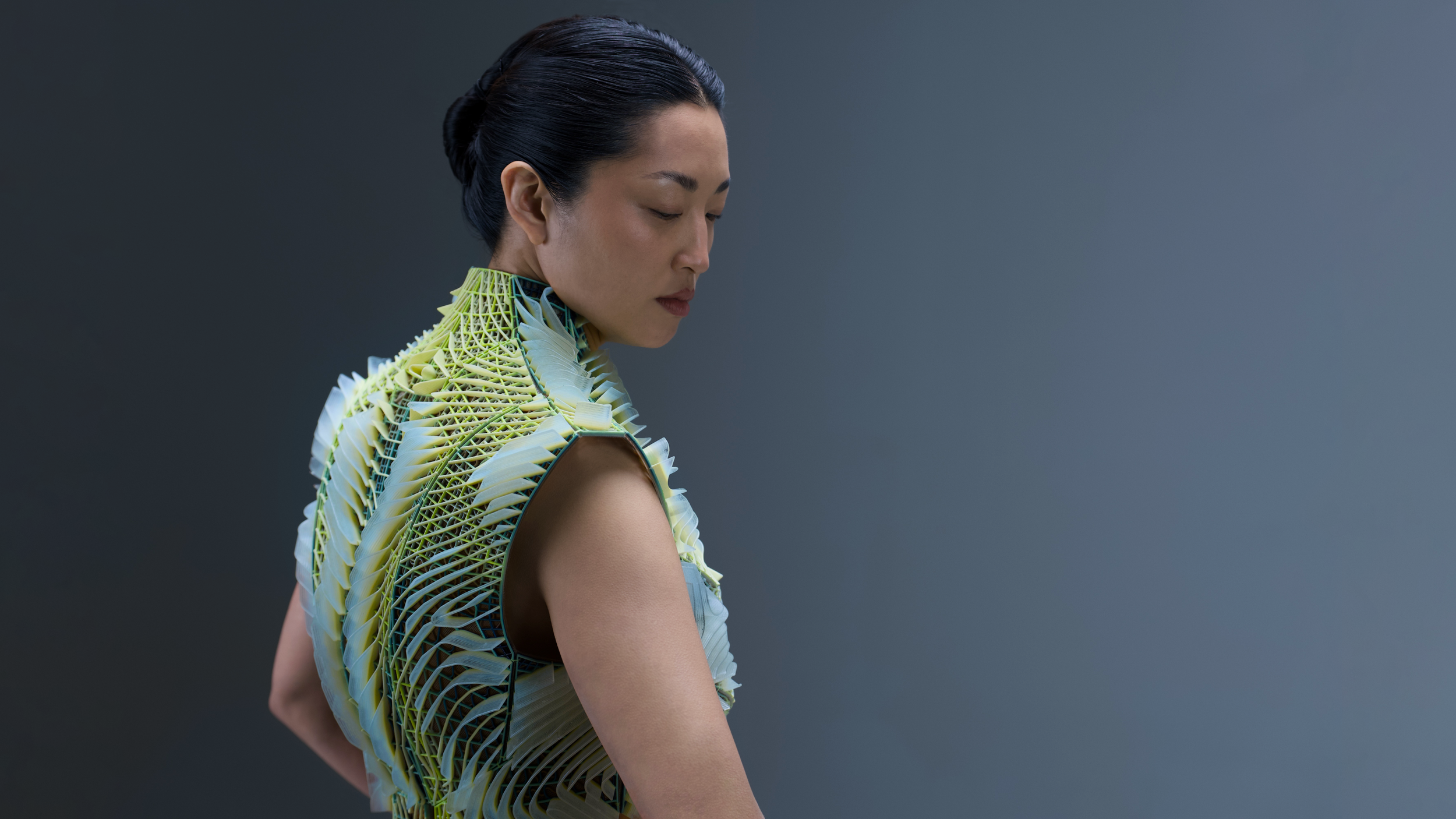
Adaptive System by Laura Civetti, worn by Rowena Lee. Photo: Gabriele Pampanelli
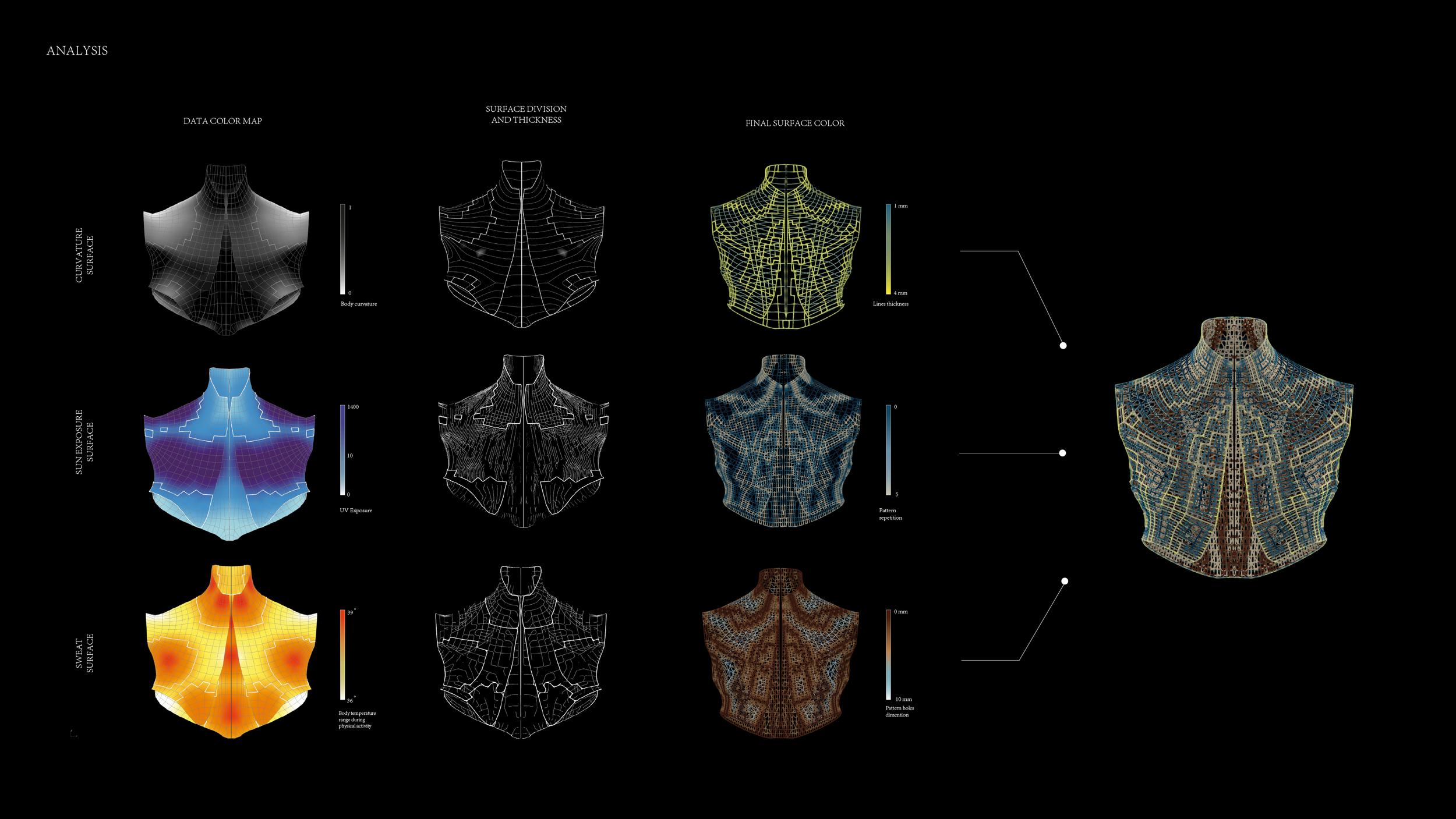
Analysis: colour maps of body curvature, sun exposure and sweat, translated into line thickness, pattern repetition and hole size, then combined into a single surface. Diagram: Laura Civetti
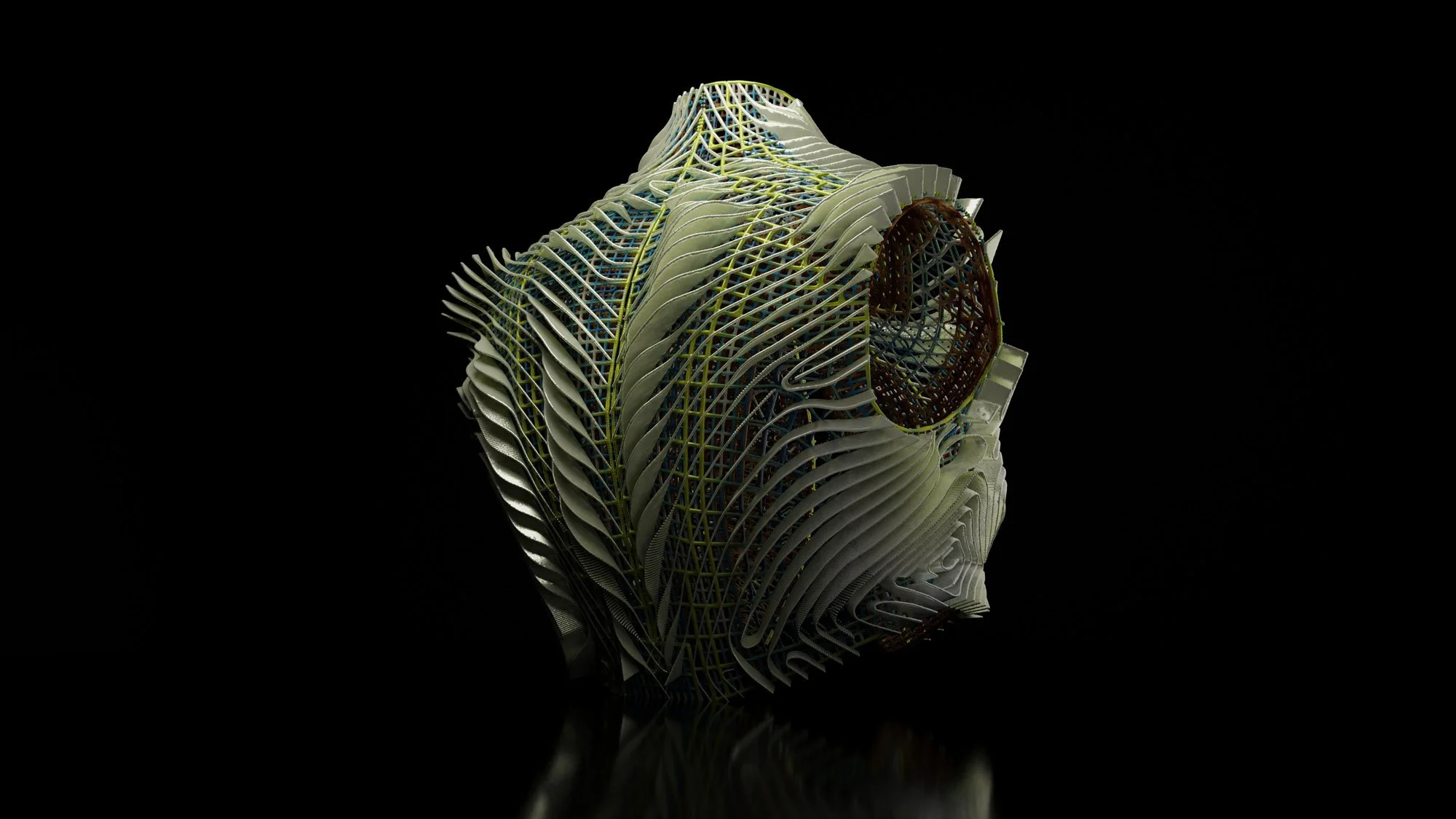
Render of the garment, back view. Rendering: Laura Civetti
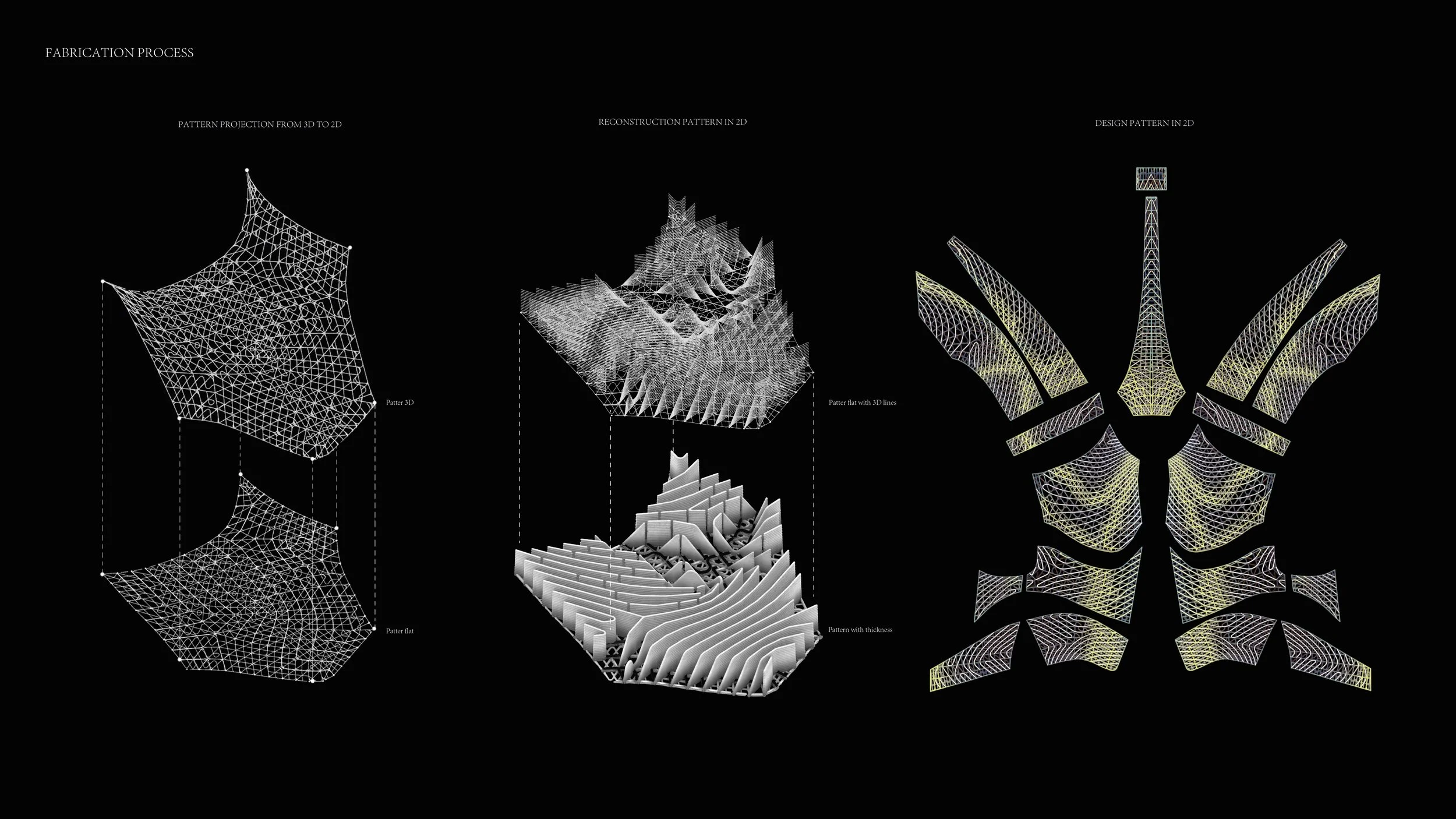
Fabrication process: the 3D pattern is flattened to 2D, given thickness, and divided into pattern pieces for printing. Diagram: Laura Civetti
Project research: Laura Civetti, Juan Daniel Cabrera Cobo
https://quasizero.design/design/
Manufacturing partner: Stratasys
Photography and video: Gabriele Pampanelli
Model: Rowena Lee
Rendering and diagrams: Laura Civetti